Management Students
Understand business through real company stories, not only theory.
About the book
This is not a book of abstract theory. It is a collection of practical stories showing how companies made choices in the real world — often under constraint, competition, regulation, or crisis.
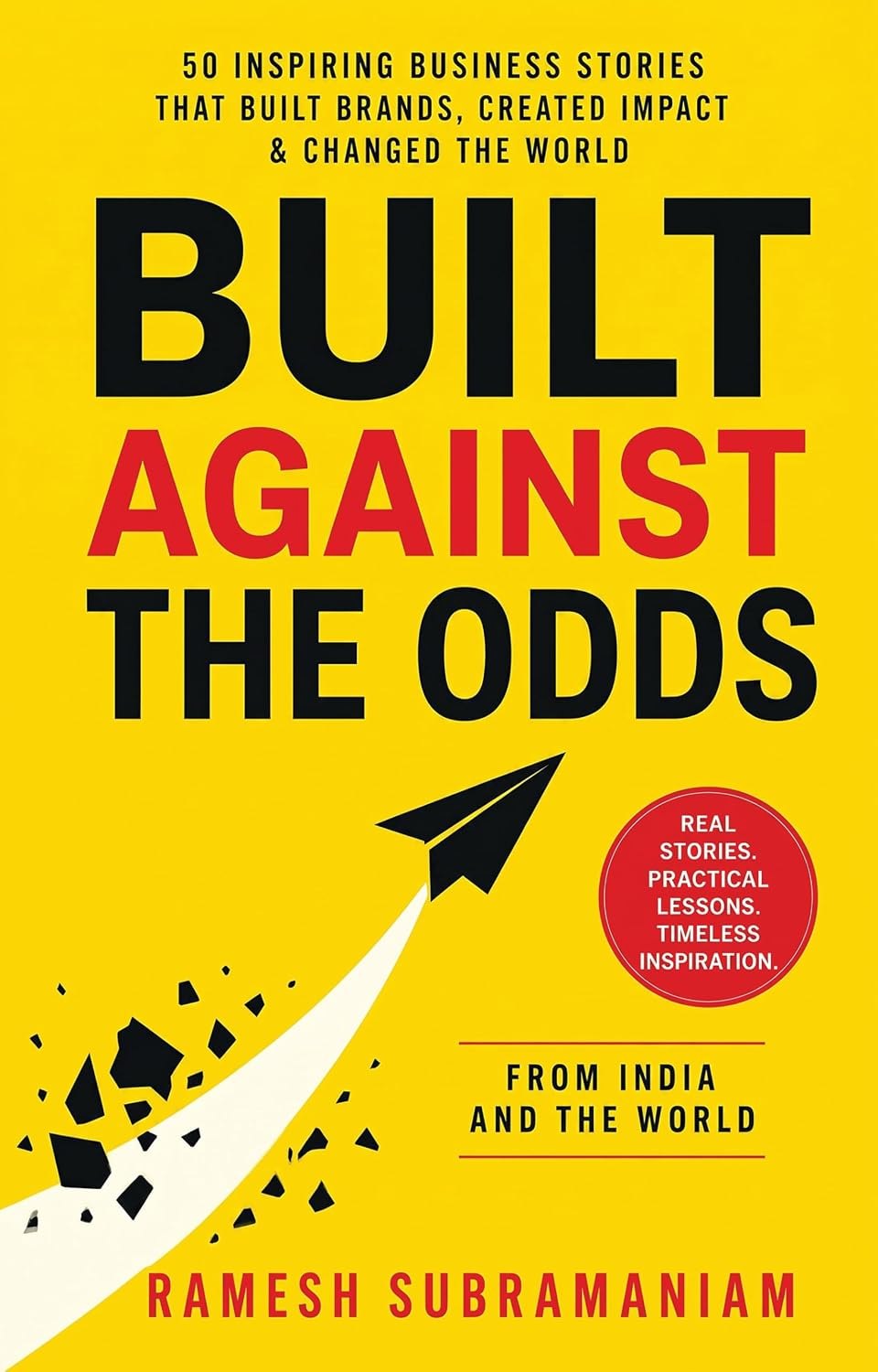
Why this book was written
In the author’s words: “This book is written for management students, management professors, and managers working in companies. I have selected 50 companies in India and abroad that have done inspirational work to build and grow their businesses.”
The companies are grouped into chapters highlighting scale, technology, innovation, small businesses with extraordinary growth, and visionary management. The grouping is deliberate: it lets you compare how very different firms answered the same underlying question.
What is clear from these stories is that success comes from taking ideas to their final stage and having the courage to face challenges and overcome them. Overcoming failures and a long-term perspective have been the hallmark of these companies.
Ramesh Subramaniam
Who it is for
Understand business through real company stories, not only theory.
Learn how companies think about scale, customers, trust, and execution.
See how small beginnings can become powerful institutions.
Discover how Indian and global companies built enduring brands.
What makes the stories useful
Each story stands on its own. You can read one over a coffee break, or assign three of them as a week’s reading, without needing the rest of the book first.
Because companies are grouped by the problem they solved, you can put Nirma next to Havells, or D-Mart next to Amul, and see two different answers to one question.
Nokia and Café Coffee Day sit in the same book as Reliance and Infosys. The stories that ended badly are the ones that teach the most about risk.
Most cases are drawn from India, in Indian market conditions — with Google, Amazon, Nike, Bose, Safran, and Nokia included for contrast.
The eight themes
Eight parts, 50 companies. Open any part to see every company and the lesson it carries.
Part 01
How small players challenged larger competitors through affordability, focus, and customer insight.
6 stories
Part 02
How companies used ambition, capital, execution, and timing to build at national scale.
8 stories
Part 03
How distribution, availability, and customer access became strategic advantages.
6 stories
Part 04
How technology, process discipline, and platforms transformed industries.
8 stories
Part 05
How trust, governance, service, and people practices created enduring institutions.
7 stories
Part 06
How companies survived shocks, changed direction, and rebuilt relevance.
5 stories
Part 07
How product thinking, branding, technology, and originality created lasting advantage.
8 stories
Part 08
How risk-taking and operating discipline shaped airline businesses.
2 stories
A sample of the thinking
Every company in the book resolves to a single transferable lesson. Here are four of them, verbatim from the chapter list.
Frugal Disruptors
A low-cost product can challenge a giant when pricing, distribution, and customer demand reinforce each other.
Sales and Distribution Experts
Supplier trust, cost discipline, and store economics can become a durable retail advantage.
Trust and Institution Building
Treating labour welfare and townships as core strategy — not philanthropy — produces a century of licence to operate.
Reinvention and Resilience
Market leadership is no defence against a platform shift you decline to take seriously.
What readers will learn
01
Turn constraints into strategy.
02
Build trust as a competitive advantage.
03
Use distribution as a moat.
04
Scale without losing focus.
05
Invest in technology before it becomes fashionable.
06
Survive crises and reinvent themselves.
07
Build brands that last across generations.
08
Convert operational discipline into market leadership.
Get the book
Available now in paperback across India and on Amazon worldwide.
Ordering for a college, cohort, or company? Ask about bulk orders.